













Have you ever felt detached from reality? As if you’ve floated beyond your skin and are existing suspended in the air, watching your physical self? It sounds like something out of a sci-fi movie, but it’s common and it has a name: depersonalization-derealization.
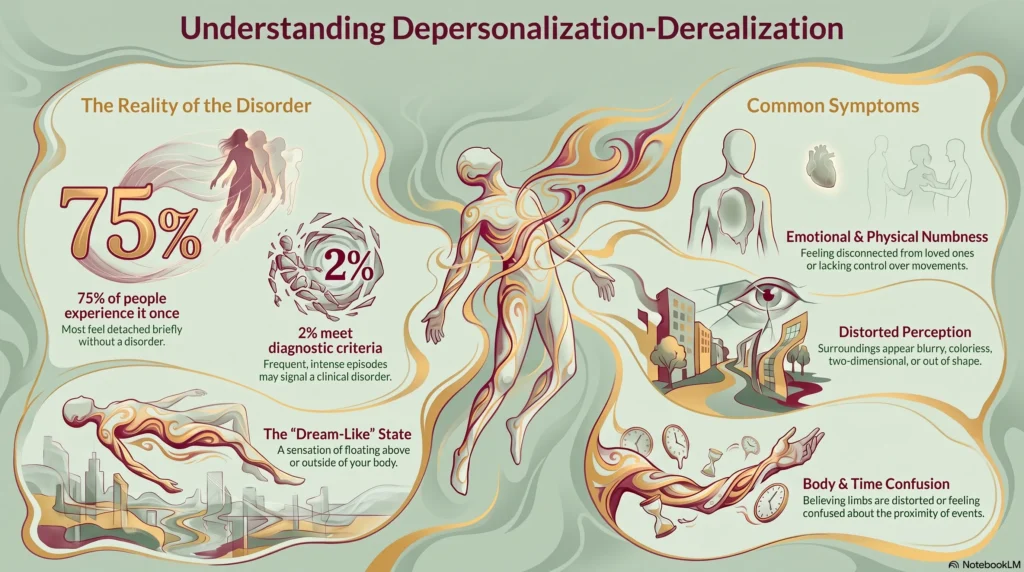
Up to 75% of people experience at least one depersonalization/derealization episode in their lives. When episodes occur regularly and increase in intensity, it can be the sign of a depersonalization-derealization disorder, which is a dissociative disorder. Only 2% of people meet the criteria for such a diagnosis, and women are more likely to develop it than men [1].
What Is Depersonalization-Derealization Disorder?
Depersonalization-derealization disorder is when you regularly feel like things around you are not real, and that you’re floating outside or above your body. Some people report that depersonalization-derealization episodes carry the sensation of being in a dream.
Most people pass through some type of depersonalization or derealization during their lives without any impact and without developing a disorder. If the episodes keep reoccurring or disrupt your ability to function, you likely have depersonalization-derealization disorder.
Depersonalization-derealization disorder can affect relationships, work, and daily activities, but effective treatment does exist.
Symptoms of Depersonalization-Derealization Disorder
Symptoms for depersonalization-derealization disorder typically start to manifest in teenage years or early adulthood. Episodes can last for hours, days, weeks, or months and can fluctuate in intensity during that time.
Symptoms include:
| Feeling like you see your body, feelings, and thoughts from outside of you | Feeling like you’re not in control of what you say or how you move |
| Believing that your limbs are twisted or larger or smaller than usual | Emotional and physical numbness |
| Concern that your memories are not your own | Feeling like people and things around you are not real |
| Feeling emotionally disconnected from loved ones | Seeing surroundings as blurry, colorless, or out of shape |
| Seeing things as two-dimensional | Feeling confused about time and the proximity of events |
What Causes Depersonalization-Derealization Disorder?
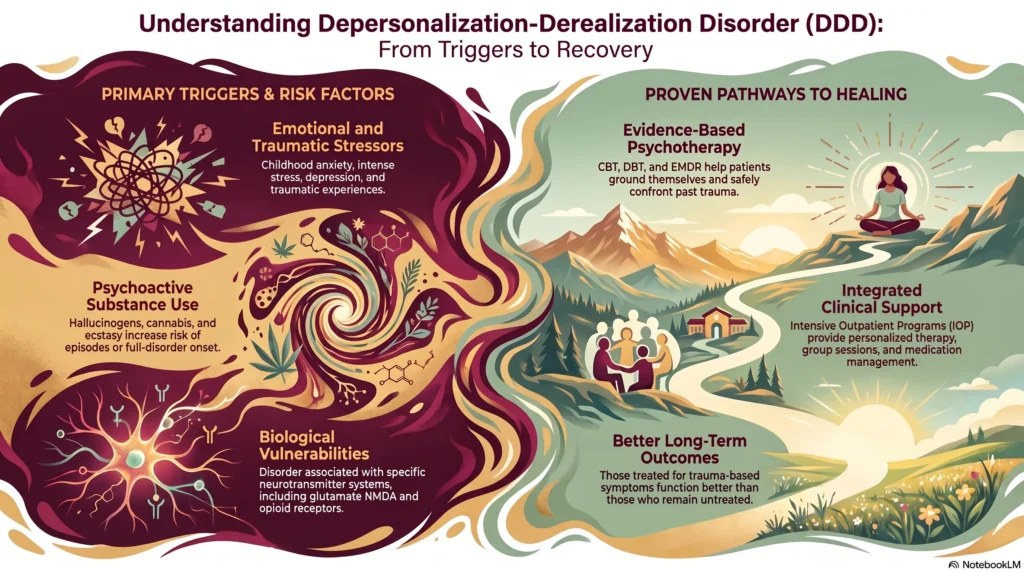
Further research is still needed to understand the exact reasons someone develops depersonalization-derealization disorder. But, factors that are common triggers for the disorder include [2]:
- Traumatic experiences
- Childhood anxiety
- Intense stress
- Depression
- Panic attacks
- Ingesting psychoactive substances
Substances can increase the risk of having a depersonalization-derealization episode that lasts a short time, or they can increase the likelihood of developing the full disorder. For people who have experienced either an episode or the onset of the disorder, the symptoms are confusing because they mimic many of the effects of the substance itself.
Hallucinogens, cannabis, and ecstasy have all been linked to depersonalization-realization disorder when ingested [3]. Neurotransmitter systems such as glutamate NMDA receptor antagonists, cannabinoids, and opioid receptor antagonists have also been associated with the disorder [4].
Is There Treatment For Depersonalization-Derealization Disorder?
Yes, treatment is available for depersonalization-derealization disorder, and is concentrated around psychotherapy (talk therapy). Currently, no medications have been approved to treat the disorder specifically, but there are medicines to treat some symptoms or underlying mood disorders such as depression that are common with depersonalization-derealization disorder.
Cognitive Behavioral Therapy (CBT), Dialectical Behavior Therapy (DBT), and psychodynamic therapy are the main treatment approaches. They focus on managing and reducing symptoms, learning techniques to be grounded in reality, coping mechanisms to deal with stress, and identifying other mental health conditions. Eye Movement Desensitization and Reprocessing (EMDR) may also be used to safely confront past trauma and alleviate its effects.
People treated for trauma-based dissociative symptoms function better and have fewer residual symptoms than those who go untreated [5].
Intensive Outpatient Program at Colorado Mental Health Services
Our Intensive Outpatient Program (IOP) treats mental health conditions, helping you connect with yourself and the world in the healthiest possible way. We have a team of licensed clinicians who personalize all care around your needs and experiences.
Our sessions include individual and group therapy, as well as holistic activities to nurture your mental, physical, and spiritual health. We also offer medication management to help you feel balanced, inside and outside of sessions.
We’re based in Lakewood, a short drive away from Denver, and are surrounded by the beautiful Front Range mountains. We also have virtual services for people who are unable to come to our center in person, ensuring you have access to the high-quality mental health care you deserve.
Healing is possible. It can start with a phone call. Speak with our admissions team today.

Sources
[1] National Alliance on Mental Illness. (2026). Dissociative Disorders. nami.org.
[2] Singh Wilkhoo, H. et al. (June 2024). Depersonalization-Derealization Disorder: Etiological Mechanism, Diagnosis and Management. Discoveries.
[3] Simeon, D. et al. (October 2009). Is depersonalization disorder initiated by illicit drug use any different? A survey of 394 adults. Journal of Clinical Psychiatry.
[4] Salami, A. et al. (November 2020). Symptoms of depersonalisation/derealisation disorder as measured by brain electrical activity: A systematic review. Neuroscience & Biobehavioral Reviews.
[5] Brand, B. et al. (June 2011). Where Are We Going? An Update on Assessment, Treatment, and Neurobiological Research in Dissociative Disorders as We Move Toward the DSM-5. Journal of Trauma & Dissociation.