













You’ve recognized that you need help with your mental health. You’ve found a treatment center and a program that delivers what you need. You’ve called admissions and verified your insurance. These are all huge steps that you should feel proud of — they show strength and they’re taking you closer to healing.
The next step is getting a mental health evaluation. The team from your chosen health center will conduct this to understand your medical history, any physical and mental challenges you’re facing now, and use the information to tailor your care to you. Research shows that personalized care can improve your engagement with treatment, as well as your treatment outcomes [1].
In this article, I explain what happens during a mental health evaluation, why, and how you can prepare for it.
What Is a Mental Health Evaluation?
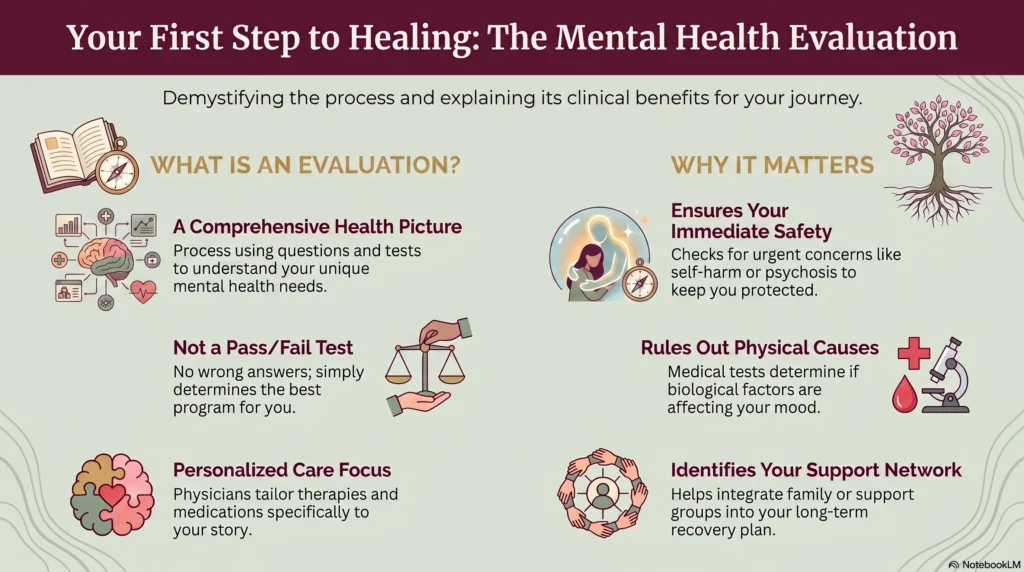
A mental health evaluation is a process where medical professionals ask you questions and carry out tests to get a full picture of your mental health. It’s sometimes called a psychiatric evaluation or a mental health assessment.
The evaluation typically takes place once you have reached out to a health center and are ready to start a program. It’s not a test with right or wrong answers, it’s simply to understand your stability and symptoms before you undergo care. It’s unlikely that you’ll be denied care based on the evaluation, but you may be recommended a different program if one better suits your needs.
While a mental health evaluation can sound scary, physicians take care to make the process as calm as possible. They don’t pass judgment and they’re not trying to catch you out with anything. The goal is to get to know you, to personalize your care, and maximize your chances of recovery.
Why Is a Mental Health Evaluation Important?
There are several reasons why a mental health evaluation matters:
- You receive an accurate diagnosis. The evaluation is a time when the physician can confirm, based on your description of symptoms and general functioning, if you meet criteria for a mental health disorder. For many people, being able to name what they’re experiencing is extremely useful.
- Your subsequent care is informed and personalized. The physician doing the evaluation works directly with your care team to offer you therapies, medication, and activities that align with your mental health needs.
- You’re kept safe. The evaluation checks for immediate concerns that could put you or others in danger, such as self-harm, psychotic episodes, or suicidal thoughts.
- You have a starting point to track progress. The information from your evaluation serves as the beginning of your recovery story. It’s something you and your care team can refer back to as you move through treatment, and see how far you’ve come.
- You have a clear idea of your support network. The physician will ask you who is helping you (e.g., family or friends) and can find ways to integrate them in your treatment so you have consistency. If you don’t have a network, the physician may suggest more social-focused approaches in your plan, such as joining a support group like 12-step or SMART Recovery.
- You can rule out other possible health conditions. Medical tests can help determine if biological factors are impacting your mental health, such as hormone changes. If so, the physician may recommend a different course of care.
Research backs the importance of a mental health evaluation. Initial measures of clinical distress have been found to be significant predictors of the patients’ mental health trajectories [2]. And, early detection and management of mental health conditions have been found crucial for improving treatment outcomes [3].
What Happens in a Mental Health Evaluation?
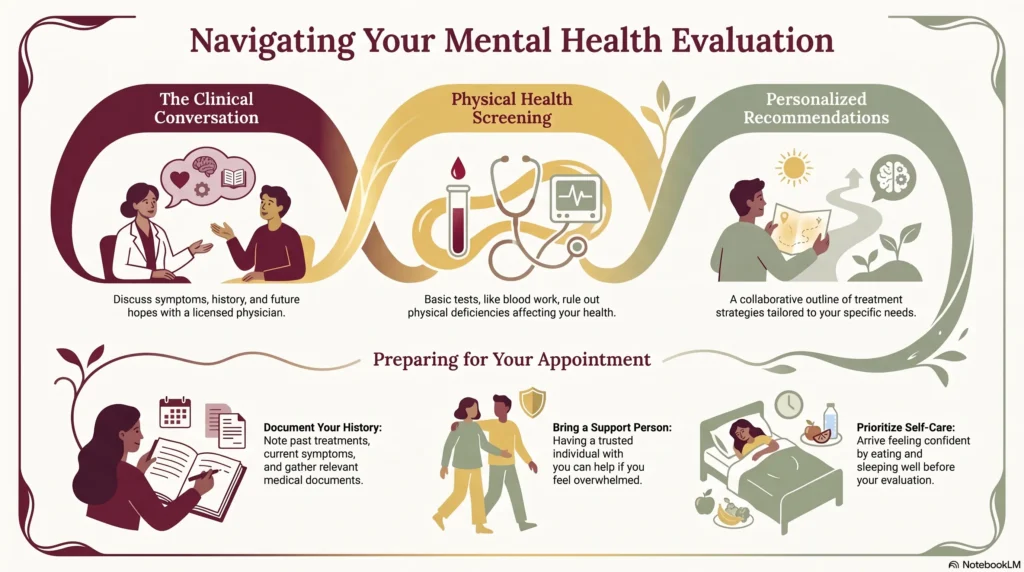
A mental health evaluation can be broken down into three main parts:
- A conversation
- Tests
- Physician recommendations
The conversation takes place between you and a licensed physician. They’ll ask you questions about your:
- Mental health symptoms
- Physical health
- Medical history
- Thought patterns and behaviors
- Housing and financial situation
- Employment
- Support network
- Use of drugs and alcohol
- Exposure to trauma
- Future hopes
You only have to share what you feel comfortable with, but keep in mind that the more information you provide, the more tailored your care will be.
After the conversation, the physician may run some basic tests to check your physical health. These include blood tests to confirm that you don’t have any deficiencies or any substances in your system that could affect treatment.
Next, the physician will talk with you about the recommended course of treatment. They’ll explain what strategies they think are appropriate for you and for how long. They’ll invite you to ask questions and to raise any concerns. Remember that this recommendation is an outline, not a manual — your care team may follow it but they can always update it in real time depending on how you respond.
How Should I Prepare?
A mental health evaluation doesn’t have to be an extra task when you’re already at a vulnerable point in life. But taking some simple actions to feel prepared can help you arrive at the appointment feeling confident and clear.
- Choose someone trusted to bring with you to the evaluation (you don’t have to take someone, but it can help if you feel overwhelmed at any point)
- Make notes about what you’d like to discuss regarding your mental health and overall health
- Consider any previous mental health treatment you’ve had and what did/didn’t work
- Gather documents about your medical history to take with you
- Prepare questions beforehand; you can also bring a device or pen and paper to write questions down as you go through the evaluation
- Sleep and eat well in the time before the evaluation
A Safe, Trusted First Step at Colorado Mental Health Services
Our trauma-informed outpatient program begins with a mental health evaluation. Our team walks you through the assessment with expertise and empathy, ensuring that we learn about you beyond your symptoms.
We use information from your evaluation to shape care around you, helping you reconnect with the healthiest version of yourself. We provide evidence-based therapies, medication management, and holistic approaches to restore your sense of balance and move you forward in recovery.
Our center is in Lakewood, a short drive away from Denver, and is surrounded by the beautiful Front Range mountains. We also have virtual services for people who are unable to come to our center in person.
Healing is possible. It can start with a phone call. Speak with our admissions team today.

Sources
[1] Li, W. et al. (2024). The efficacy of personalized psychological interventions in adolescents: a scoping review and meta-analysis. Frontiers in Psychology.
[2] Fernández-Álvarez, J. et al. (2024). Intake Characteristics as Predictors of Psychotherapy Outcome in a Practice Research Network in Argentina. Administration and Policy in Mental Health and Mental Health Services Research.
[3] Lal Vallath, A. et al. (2024). The importance of rapid assessment tools in evaluating mental health in emergency departments among patients with chronic diseases. Frontiers in Public Health.