














Your mental health is as important as your physical health. And just like your physical health, it needs treatment when something doesn’t feel right. Mental health is fragile and can change due to life events, genetics, or other factors. When there’s a change that leaves you in a persistently low mood or struggling to function on a daily basis, mental health treatment provides a safe way back to stability.
Over 23% of adults in the US experienced a mental health illness in 2024 [1]. Despite rates of mental health conditions increasing over recent years, there’s still a gap between the number of people with a mental health diagnosis and the number of people seeking mental health treatment [2]. In rural areas, the disparity is particularly strong [3].
Getting help for mental health shows strength and is the first step to feeling better. Let’s take a look at how to do it in rural Colorado.
What Is Mental Health?
First, let’s define what ‘mental health’ refers to. Centers for Disease Control and Prevention states that it’s “the component of behavioral health that includes our emotional, psychological, and social well-being […] enables us to cope with the stresses of life, realize our abilities, learn well and work well, and contribute to our community” [4].
Your mental health can naturally fluctuate, but there’s a difference between having a bad day and feeling down, versus having a mental health disorder (also called a mental health condition or illness). A mental health disorder affects your feelings, mood, and behavior; it often causes you distress and impacts your ability to carry out basic daily tasks.
The most common mental health disorders include:
Mental health disorders require treatment. They do not go away by themselves — they need structured care to help you manage symptoms and medication, learn coping mechanisms, and build support systems that ensure you live a fulfilled life.

What Are Signs That You Need Mental Health Care?
Shifts in mental health can be subtle. It can be hard to tell whether you’re having a rough few days or something more. Your environment, culture, and gender can also influence how easily you recognize that your mental health is suffering.
The sooner you’re able to tell if you need mental health care, the sooner you can seek the best support for you and start moving forward. Some of the signs that could indicate you need formal mental health treatment include:
- Problems sleeping
- Changes in appetite
- Social withdrawal
- Substance use
- Fatigue
- Drops in performance at work or school
- Having relationship problems
- Ongoing irritability or aggression
- Unexplained aches and pains
- Suicidal thoughts
Research shows that mental health care is effective and helps reduce symptoms, morbidity, and mortality among people with mental health disorders [5]. It can also contribute to more positive emotional expression [6].
What Type of Mental Health Care Is There?
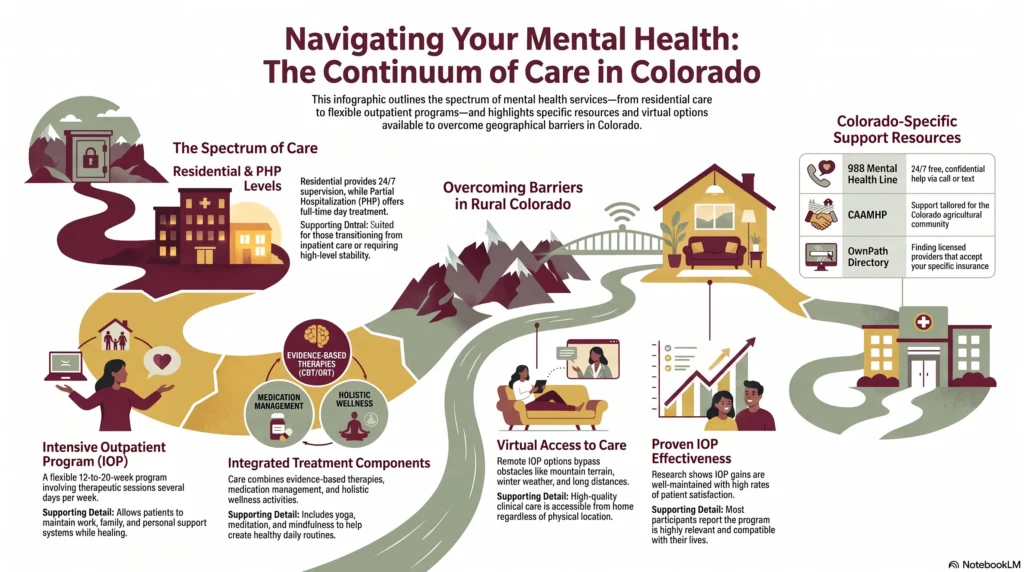
There are several types of mental health programs that are available. The continuum of care connects levels of mental health care and shows what you can choose from. It looks like this:
Residential care: Staying overnight at a mental health facility while receiving care. This type of treatment involves being supervised 24/7 and is suited to people who aren’t stable enough to live independently.
Partial Hospitalization Program (PHP): Attending therapeutic sessions at a health facility during the day but returning home in the evening. Best suited to people who have finished a residential program or who need full-time mental health care.
Intensive Outpatient Program (IOP): Similar to PHP but with fewer hours of sessions at a health facility. People who have finished a PHP or who have family or work responsibilities often choose IOP as their preferred type of mental health care.
All mental health programs integrate evidence-based therapies such as Cognitive Behavioral Therapy (CBT) and Dialectical Behavioral Therapy (DBT) to help you identify mental health triggers and negative thought patterns, and to learn how to emotionally regulate.
Care also includes medication management for prescription drugs such as antidepressants and mood stabilizers, where the care team monitors your dosage and can recommend different medicines for your treatment plan if needed.
Wellness activities are part of care, too. Yoga, meditation, and mindfulness complement clinical treatment, promote self-care, and help you create healthy routines that maintain your mental health.
Intensive Outpatient Program For Mental Health
For many people, mental health is a priority that coexists alongside other life priorities, including having a family, working a job, or being a caregiver for someone else. Mental health care cannot be negotiable if you need it, but it can be flexible and align with your lifestyle.
For example, the IOP at Colorado Mental Health Services runs 3 days a week, for 3 hours a day. It typically lasts for 12 weeks but can be extended to 20 weeks if needed. The flexibility of the program means you receive high-quality mental health care and can continue your daily responsibilities. And, because you don’t stay overnight, you have access to your personal support systems, which can keep you motivated and focused on healing.
An IOP is not only effective at treating mental health disorders, but research also shows that gains made in an IOP are generally maintained [7]. IOPs also have high retention, and most people report high satisfaction, comfort, appropriateness, relevance, and compatibility with an IOP for mental health [8][9].
Overcome Barriers to Mental Health Care in Rural Colorado
Living in a rural area can mean that you have difficulty accessing mental health care. Challenges might include:
- Living far away from a mental health center
- Mountain terrain makes it difficult to get to a mental health center
- Weather changes affect transport to and from a mental health center (especially in winter)
- Having fewer mental health centers or limited mental health care programs
- Technological limitations that reduce research abilities into mental health services
Many mental health centers offer virtual options to join programs, to help overcome obstacles to care in rural areas. At Colorado Mental Health Services, our IOP can be joined remotely, meaning that you can access high-quality mental health care without traveling to our center.
Other resources that can support people living in rural Colorado include:
- 988 Colorado Mental Health Line: call or text 988 for free, confidential help 24/7
- Colorado Agricultural Addiction and Mental Health Program (CAAMHP): free, confidential mental health support for agricultural communities
- OwnPath Care Directory: find licensed mental health providers that accept your insurance
- Colorado LIFTS (Linking Individuals and Families to Services): help to navigate care resources in Colorado
Intensive Outpatient Program at Colorado Mental Health Services
Mental health care shouldn’t be limited by location. If you’re based in rural Colorado and need support for a mental health disorder, our IOP can help. We have a team of licensed clinicians who run our program, personalizing all care around your needs.
Our sessions include individual and group therapy, as well as holistic activities to nurture your mental, physical, and spiritual health. We also offer medication management to help you feel balanced, inside and outside of sessions.
You attend sessions during the day at our center in Lakewood, which is a short drive away from Denver, surrounded by the beautiful Front Range mountains. We also have virtual services for people who are unable to come to our center in person, ensuring you have access to mental health care if you live in rural parts of Colorado.
If you’re in Colorado and need mental health care, make sure you get it. Speak with our admissions team today and start feeling like you again.

Sources
[1] National Alliance on Mental Illness. Mental Health By the Numbers. nami.org.
[2] CDC. (September 2020). Mental Health Treatment Among Adults: United States, 2019. cdc.gov.
[3] Morales, D. et al. (May 2020). A call to action to address rural mental health disparities. Journal of Clinical and Translational Science.
[4] CDC. (May 2026). About Mental Health. cdc.gov.
[5] National Academies of Sciences, Engineering, and Medicine. (January 2018). Evaluation of the Department of Veterans Affairs Mental Health Services. National Academies Press.
[6] Ramos Miguel, R. et al. (November 2024). Effectiveness of mental-health interventions for children and adolescents placed in residential care by the welfare services: A systematic review. Children and Youth Services Review.
[7] Burton, M. et al. (April 2022). The role of depression in the maintenance of gains after a prolonged exposure intensive outpatient program for posttraumatic stress disorder. Depression and Anxiety.
[8] Watkins, L. et al. (August 2023). Clinical Effectiveness of an Intensive Outpatient Program for Integrated Treatment of Comorbid Substance Abuse and Mental Health Disorders. Cognitive and Behavioral Practice.
[9] Bador, K. et al. (March 2025). Clients’ Experiences and Satisfaction with an Integrated Intensive Outpatient Program for Substance Use Disorders. Actas españolas de psiquiatría.