













You look away from what you’re doing for a few seconds and suddenly it’s been minutes and you’ve lost yourself in a completely novel mental scenario. Even if you try to retrace the thread of how you got there, you simply can’t.
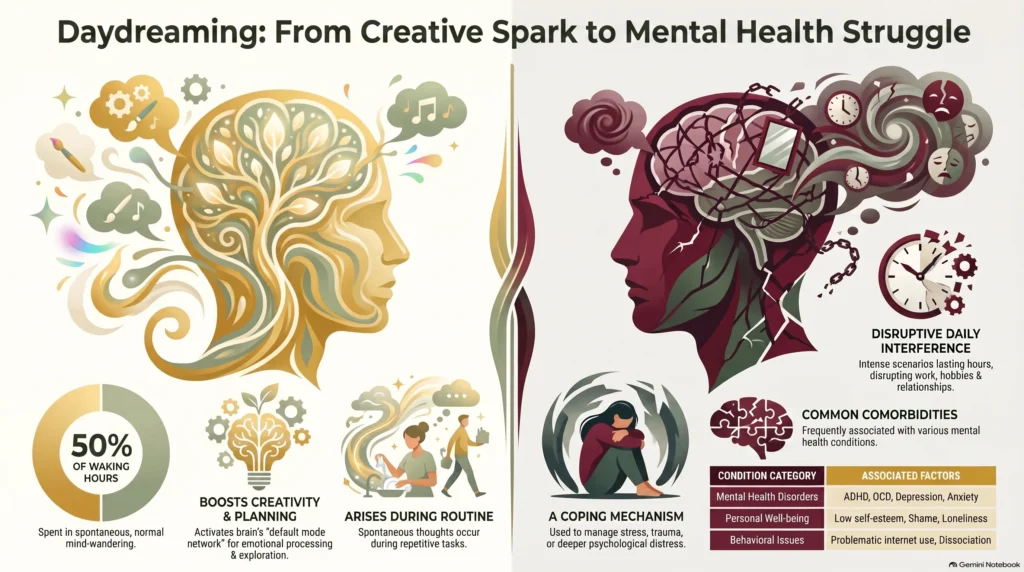
Daydreaming is normal, we actually spend nearly half of our waking hours doing it [1]. And daydreaming can be a good thing: it can spark creativity and allow the brain to explore different angles and perspectives of our experiences. But excessive daydreaming can be detrimental to mental health, and daydreaming that feels intense and interferes with your daily functioning may be a condition called maladaptive daydreaming.
Below, I explain what daydreaming is and when it’s reflective of a mental health problem that requires treatment.
What Is Daydreaming?
Daydreaming is when you lose focus on what you’re doing (consciously or unconsciously) and your attention goes to your thoughts, usually about imagined scenarios or future plans. It happens while you’re awake and is also known as mind wandering. Daydreaming can happen without a stimulus and is closely connected to your mood.
We daydream out of a spontaneous cognitive process that mostly arises when we’re doing routine tasks. In these moments, the brain’s default mode network activates as a way to help process emotions, plan, and deal with stress.
Daydreaming can happen during any activity, and rarely drops to below 30% of the time you spend doing a task. Yet daydreaming can become dangerous if it occupies too much of your brain space. As psychologists Matthew Killingsworth and Daniel Gilbert have said: “the ability to think about what is not happening is a cognitive achievement that comes at an emotional cost” [2].
What Is Maladaptive Daydreaming?
Maladaptive daydreaming is not a formal medical diagnosis, but it is a recognized condition associated with mental health disorders. It’s when a person spends excessive amounts of time, often hours, daydreaming, to the point where their work, hobbies, and relationships are disrupted. It can cause the person significant distress and is often a coping mechanism for problems or a deeper mental health issue.
Research shows maladaptive daydreaming is commonly associated with the following [3]:
- Depression
- Anxiety
- Dissociation
- OCD
- ADHD
- Autism Spectrum Disorder
- Trauma
Maladaptive daydreaming is also linked to difficulties in emotional regulation, loneliness, dysfunctional personality traits, shame, problematic internet use, and psychological distress. People who are maladaptive daydreamers tend to have low self-efficacy and self-esteem.
Signs of Maladaptive Daydreaming
Someone who maladaptive daydreams tends to:
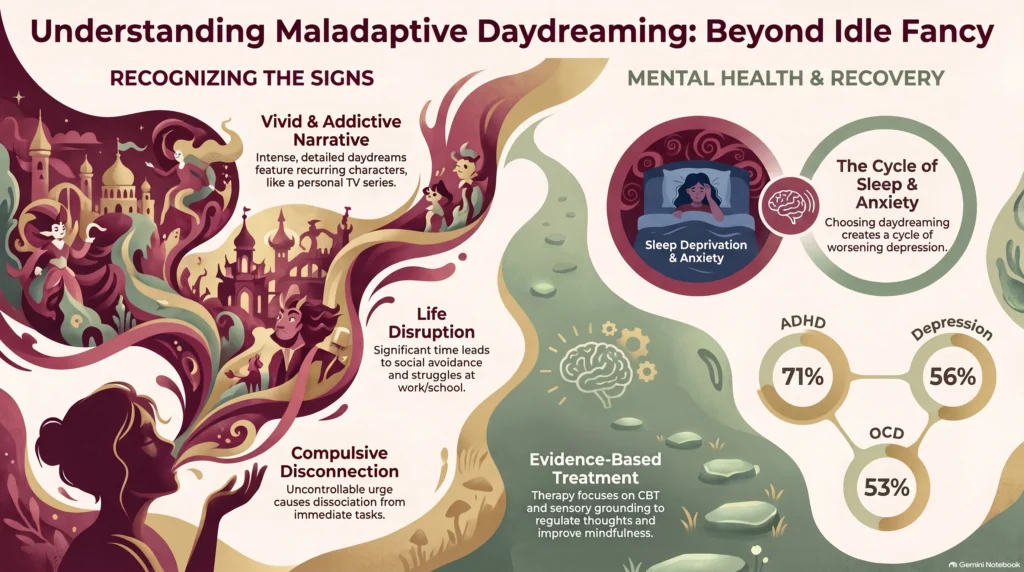
- Have intense daydreams that are vivid and detailed
- Have daydreams with repeated characters, almost like a TV series
- Spend hours or significant amounts of time daydreaming
- Be able to intentionally start daydreaming
- Disconnect from their surroundings and tasks, similar to dissociation
Maladaptive daydreaming does not mean confusing daydreams with reality. Usually, the person can differentiate the two, but they may feel a compulsive need to daydream that they can’t control.
A person who regularly has maladaptive daydreaming episodes may exhibit behaviors such as:
- Avoids social situations
- Struggles to perform at work or in other areas of life
- Has feelings of guilt and shame
- Makes repeated attempts to stop or reduce their daydreaming
Maladaptive Daydreaming and Mental Health
Maladaptive daydreaming can be a symptom of a mental health disorder. One study found nearly 71% of participants with maladaptive daydreaming had ADHD, 56% had depression, and 53% had OCD [4].
Individuals who experience maladaptive daydreaming say it’s more intense and time-consuming on the days where they also are experiencing other symptoms.
People who are maladaptive daydreamers also commonly report their daydreaming to be pleasurable and addictive, which may confirm it as a tool to escape anxious and obsessive thoughts. At the same time, there’s evidence that maladaptive daydreaming has a positive reinforcement process comparable to addiction disorders [5].
The condition can impact sleep, too. People who engage in maladaptive daydreaming may struggle to sleep because they prefer to daydream, which can lead to sleep deprivation that worsens how mental health disorders manifest. Anxiety and depression are both associated with little, or poor quality, sleep [6].
When Daydreaming Requires Treatment
If you recognize the signs of maladaptive daydreaming in yourself, seeking treatment is a good next step. Or if you already have a diagnosed mental health disorder and notice that you have been using daydreaming as a tool to mask or alleviate your symptoms, that also indicates you might need treatment.
There’s no standard treatment for maladaptive daydreaming yet. However, because cognitive behavioral therapy (CBT) is effective for depression, anxiety, and other dissociative disorders, it can help people with maladaptive daydreaming better understand how they think and why their mind wanders so much.
Research additionally highlights that sensory grounding techniques have been useful to help people who dissociate, and so they may aid people with maladaptive daydreaming tendencies [5].
Mental Health Treatment at Colorado Mental Health Services
At our center in Lakewood, we offer a trauma-informed outpatient program designed to treat mental health disorders and symptoms, including maladaptive daydreaming. We integrate evidence-based therapies (such as CBT), and we curate a tailored care plan that considers your clinical history and current stressors. There are also a range of holistic activities available as part of treatment to help you regulate and improve mindfulness as you heal.
Whether you’re at the very beginning of your journey, or have sought care before, our program is effective and designed to support you as you move forward. We don’t judge and we don’t overpromise — we meet you where you are right now.
Start with a conversation. Call our admissions team.

Sources
[1] Killingsworth, M. Gilbert, D. 2010. A Wandering Mind Is an Unhappy Mind. Science.
[2] Bradt, S. 2010. Wandering mind not a happy mind. The Harvard Gazette.
[3] Somer, E. et al. 2025. Maladaptive Daydreaming and Psychopathology: A Meta‐Analysis. The International Journal of Psychology.
[4] Somer, E. et al. 2017. The Comorbidity of Daydreaming Disorder (Maladaptive Daydreaming). The Journal of Nervous and Mental Disease.
[5] Soffer-Dudek, N. Somer, E. 2018. Trapped in a Daydream: Daily Elevations in Maladaptive Daydreaming Are Associated With Daily Psychopathological Symptoms. Frontiers in Psychology.
[6] Bard, H. et al. 2023. Insomnia, depression, and anxiety symptoms interact and individually impact functioning: A network and relative importance analysis in the context of insomnia. Sleep Medicine.