













If you’ve ever felt like your surroundings aren’t real or that you’re existing in a dream, you’ve probably had an episode of derealization. Derealization isn’t a mental health disorder itself — it’s actually a very common state that people experience for a short amount of time — but if it occurs regularly, that can be a sign of a deeper mental health issue.
Up to 75% of people say they’ve experienced derealization at some point in their lives [1], which can be a normal response to trauma, high stress, or fatigue. Frequent episodes that grow in intensity may signal a mental health condition such as depression and anxiety.
Here’s what derealization is, why it happens, what it can lead to, and treatment that’s available.
What Is Derealization?
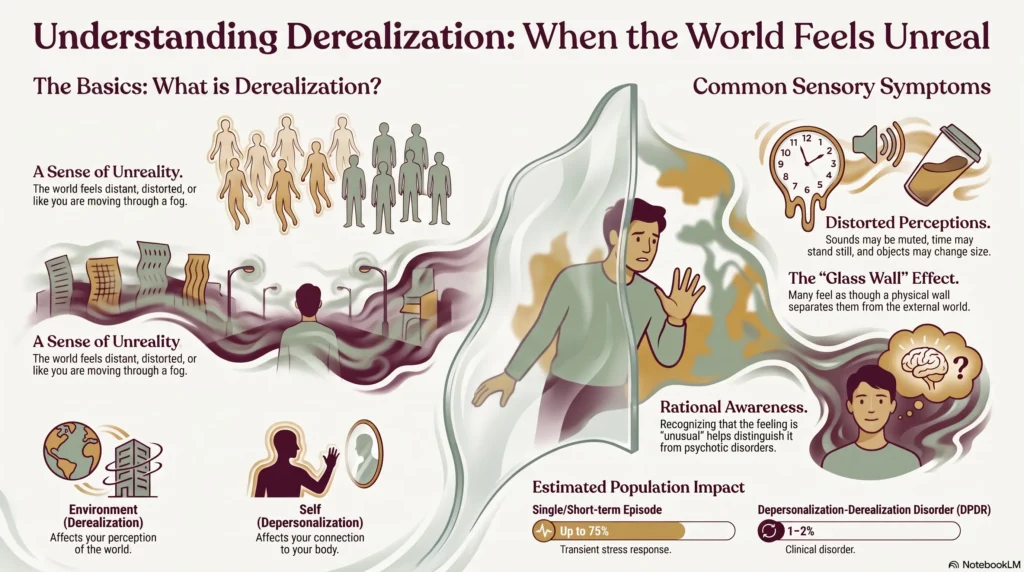
Derealization is a mental state where you see the world around you as distorted, distant, or unreal. People and objects may feel like they’re not actually there, and you may have the sense you’re moving through a fog or there’s something separating you from your surroundings.
Most people experience derealization at least once: it arrives and passes. For others, episodes can last for hours or even months. It’s different from depersonalization, which is when you feel disconnected from your physical body, often seeing yourself floating outside of, or above, yourself. However, it’s possible to have derealization and depersonalization happen at the same time, and if both occur repeatedly, that may indicate depersonalization-derealization disorder (DPDR).
What Are the Symptoms of Derealization?
Symptoms of derealization are varied and can fluctuate in intensity. Some people say that symptoms make them feel like they are “going crazy,” but this recognition that something is different/unusual is actually a good sign. When someone can’t distinguish between reality and imagination, that can be the sign of a psychotic disorder.
Derealization symptoms include:
- Feeling like the world is muted or fake
- People and things seem fake, blurry, or the wrong size
- Sounds are too loud, too quiet, or distorted
- Time feels like it passes too fast, too slow, or stands still
- People around you feel unreal, you may perceive them as robots, even if rationally you know they are not
- A wall separates you from your external world
These symptoms overlap with symptoms of depersonalization-derealization disorder, a condition that can impact your relationships, work, and daily activities. Only 1-2% of the world’s population have the disorder [2].
Derealization most commonly is a symptom of other conditions, including:
- PTSD and Complex PTSD (C-PTSD)
- Depression
- Panic disorder
- Dementia
- Schizophrenia
- Substance use disorder
- Dissociative disorders such as amnesia
What Causes Derealization?
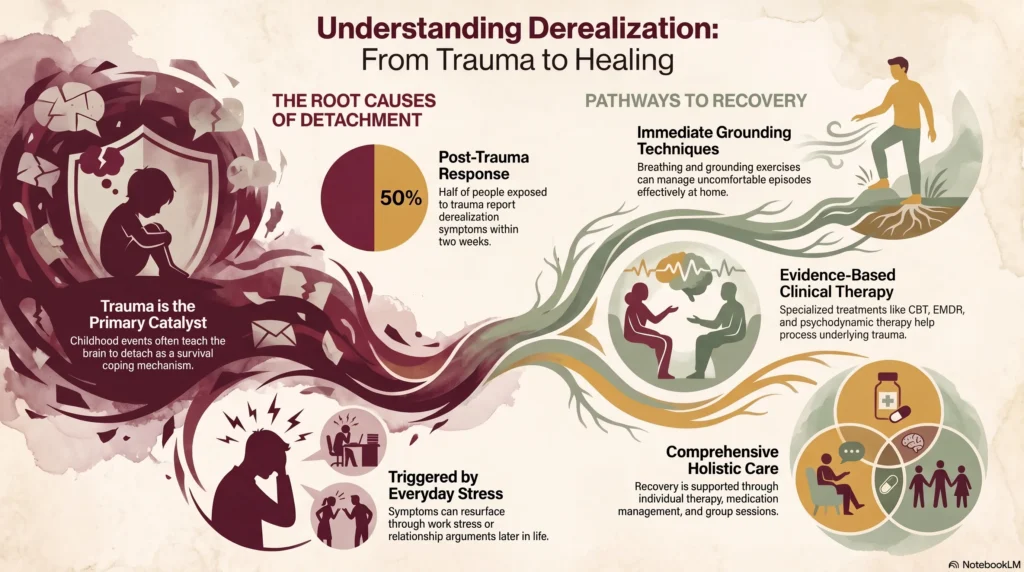
Trauma is the most common cause of derealization, especially trauma that happened at a young age. Traumatic events in childhood can teach a person to detach from the world as a coping mechanism. It includes:
- Sexual or physical abuse
- Sudden death of a loved one
- Witnessing domestic violence
- Having a relative with a severe mental health disorder
- Living in a natural disaster or conflict zone
- Being in a car accident
Episodes of derealization can be triggered by direct links to trauma, or by everyday stressors, such as stress at work or an argument in a relationship.
One study found that approximately half of people exposed to trauma reported symptoms of derealization two weeks afterward. These people also had greater symptoms of PTSD and depression three months after the trauma [3].
Overactivation in parts of the brain that control emotion regulation may lead to feelings of detachment after a traumatic event. Other areas involved in emotional experience may cause the distorted perceptions that come with derealization [3].
Is There Treatment for Derealization?
Derealization can be uncomfortable and scary, but it is not life-threatening and can typically be managed at home with breathing and grounding exercises. If your episodes of derealization last for days, feel unbearable, or are increasing in frequency and intensity, you should seek clinical help.
Treatment programs such as our Intensive Outpatient Program (IOP) provide structured care for derealization, trauma, and other mental health challenges. They integrate evidence-based therapies such as Cognitive Behavioral Therapy (CBT), psychodynamic therapy, and Eye Movement Desensitization Reprocessing (EMDR) to help you understand your thoughts, process trauma, build self-awareness, and learn new skills to manage your mental health.
There’s currently no dedicated medication to treat derealization, but antidepressants, anti-anxiety medications, and mood stabilizers may help to alleviate symptoms [4].
Treatment has been repeatedly shown to improve symptoms and general mental health in dissociative disorders [5].
Find Where You Belong at Colorado Mental Health Services
Our trauma-informed outpatient program treats mental health conditions, helping you connect with yourself and the world in the healthiest possible way. We have a team of licensed clinicians who personalize all care around your needs and experiences.
Our sessions include individual and group therapy, as well as holistic activities to nurture your mental, physical, and spiritual health. We also offer medication management to help you feel balanced, inside and outside of sessions.
We’re based in Lakewood, a short drive away from Denver, and are surrounded by the beautiful Front Range mountains. We also have virtual services for people who are unable to come to our center in person, ensuring you have access to the high-quality mental health care you deserve.
Healing is possible. It can start with a phone call. Speak with our admissions team today.

Sources
[1] National Alliance on Mental Illness. (2026). Dissociative Disorders. nami.org.
[2] Cleveland Clinic. (September 2023). Depersonalization-Derealization Disorder. my.clevelandclinic.org.
[3] National Institute of Mental Health. (June 2022). Feelings of Detachment After Trauma May Signal Worse Mental Health Outcomes. nimh.nih.gov.
[4] WebMD. (August 2024). Derealization explained. webmd.com.
[5] Griffiths, T. et al. (March 2025). Effectiveness of phase-oriented treatment for trauma-related dissociative disorders: a systematic review. European Journal of Psychotraumatology.