













Plenty of people ask how to get treatment for a mental health disorder. Fewer ask what comes next — how do you hold onto the progress once you are stable?
If you have already received ketamine therapy as part of your treatment and responded well to the first round, ketamine maintenance therapy is a way to prevent recurring symptoms.
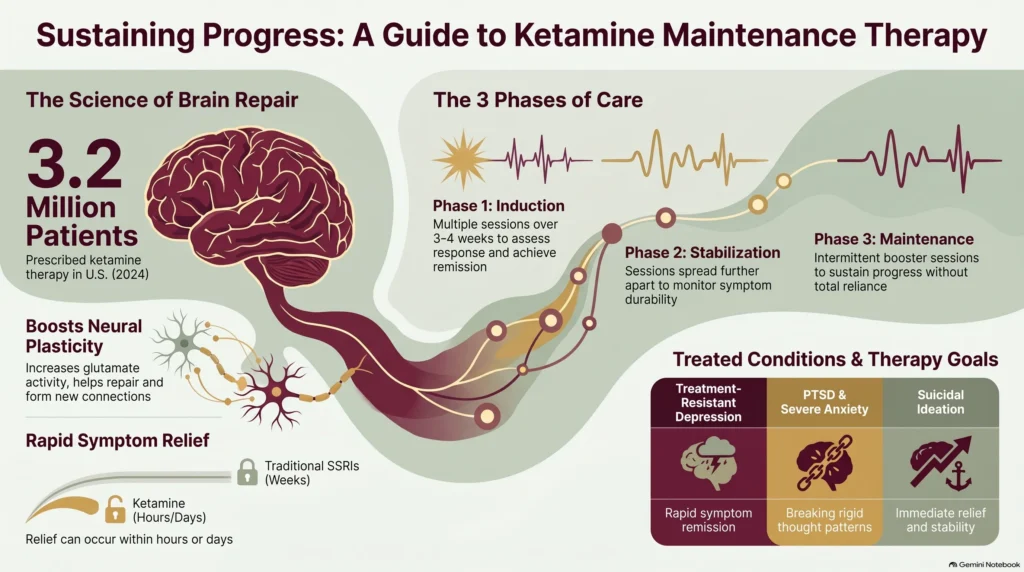
Ketamine therapy can provide immediate relief to people with treatment-resistant depression, trauma, and other mental health conditions. In the U.S., 3.2 million people were prescribed ketamine in 2024 [1]. The therapy helps support the growth of new neural connections and increases brain plasticity, but its effects can fade over time.
In this article, I explain what ketamine maintenance therapy is, how it is related to ketamine therapy, how it works, and what you can expect when moving forward with it.
What Is Ketamine Maintenance Therapy?
Ketamine maintenance therapy is a treatment process that is part of ketamine therapy. Ketamine therapy involves different “rounds” of ketamine doses under medical supervision which are given via an IV drip, an intramuscular injection, or a nasal spray. Research shows more than half of people who received ketamine therapy saw their severe depression ease to the point of remission after three infusions over 11 days [2].
But, such improvements are not permanent. To help support the positive outcomes, ketamine maintenance therapy offers ongoing, intermittent doses of ketamine to support the initial effects and to lower the risk of previous mental health symptoms returning. Think of ketamine maintenance therapy as a regular booster for ketamine therapy.
The entire treatment process looks like this:
Induction. You attend several ketamine therapy sessions over a few weeks to assess your response to the treatment. People usually see significant positive changes in this time (normally three-four weeks).
Stabilization. Your ketamine therapy sessions are spread out over a longer period of time to see the effect on your symptoms. The hope is you don’t return to your state before starting ketamine therapy.
Maintenance. You receive long-term, spread out sessions of ketamine therapy to sustain your progress without total reliance on the therapy.
What Does Ketamine Maintenance Therapy Treat?
Ketamine maintenance therapy treats the same disorders that ketamine therapy treats.
These include:
How Does Ketamine Maintenance Therapy Work?
Ketamine therapy works on glutamate — a neurotransmitter in your brain that can get damaged by depression and other mental health disorders. Unlike antidepressants such as Selective Serotonin Reuptake Inhibitors (SSRIs) which target serotonin levels, ketamine therapy increases glutamate activity, helping neurons communicate, learn, and form memories [3].
This action promotes neuroplasticity (the brain’s ability to adapt and develop from experiences) where more synaptic connections are made between neurons, and rigid, negative thought patterns can be broken more easily. Symptom relief with ketamine therapy can happen within hours or days.
Lasting changes in the brain need more time than just the induction stage of ketamine therapy. That’s where ketamine maintenance therapy comes in. By providing less frequent doses of ketamine, neuroplasticity is facilitated but is not only determined by the presence of ketamine. The goal is that eventually, the changes become fixed without ketamine at all.
How Is Ketamine Maintenance Therapy Structured?
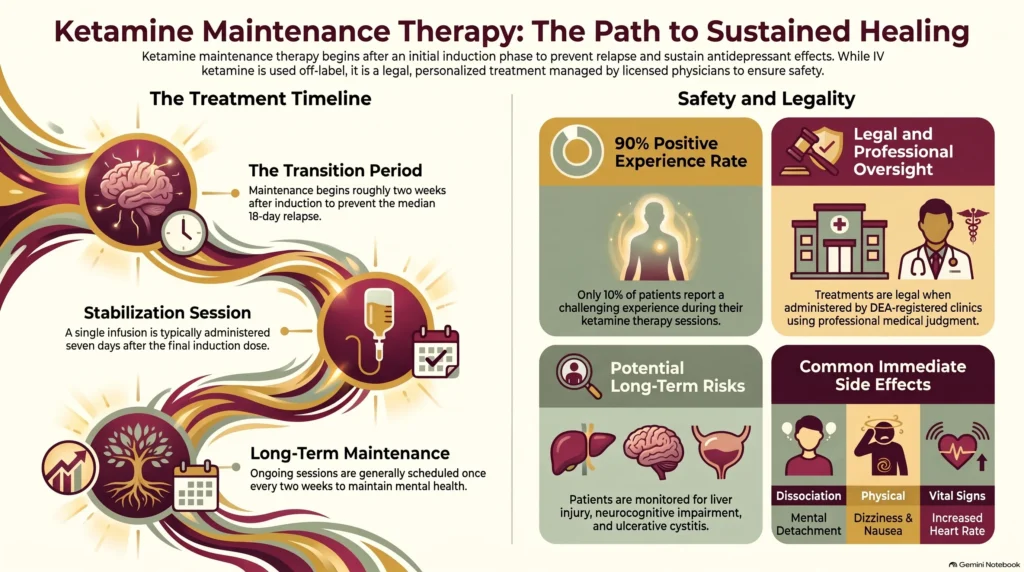
Ketamine maintenance therapy starts after the induction phase of ketamine therapy has finished. The timing depends on the individual, because each person responds differently to the therapy. However, studies suggest the median time to relapse after an initial ketamine infusion is 18 days. Most ketamine maintenance plans start around two weeks after the induction stage is completed [4].
Ketamine therapy and ketamine maintenance therapy have to be personalized: the frequency of each session/infusion depends on the person. As a point of reference, though, one trial used the following format for ketamine maintenance therapy [5]:
- Three initial infusions every other day for a week
- An infusion seven days after the last initial infusion
- Infusions every two weeks afterward
Is Ketamine Maintenance Therapy Legal?
Yes, ketamine therapy and ketamine maintenance therapy are both legal when administered by dedicated clinics with a DEA registration. However, ketamine in IV form is only approved by the FDA as an anesthetic for major surgeries. It is not approved for mental health treatment, but can be used off-label by licensed physicians. “Off-label” means doctors use their professional judgment to administer and plan ketamine therapy.
Esketamine (also called Spravato), which is a nasal spray derived from ketamine, is FDA-approved for treatment-resistant depression.
Preliminary research highlights maintenance ketamine treatment as effective in sustaining antidepressant effects in treatment-resistant depression [6].
Are There Side Effects or Risks?
Further research is still needed to fully understand the possible side effects of ketamine maintenance therapy. Generally, it is considered safe and is tolerated well, but it may carry risks for [6]:
- Ulcerative cystitis
- Liver injury
- Neurocognitive impairment
- Addiction
Ketamine maintenance therapy may also cause short-term effects immediately after receiving a dose. These include:
- Dissociation
- Dizziness
- Nausea
- Increased blood pressure and heartbeat
- Confusion
Side effects are uncommon and are rarely severe. According to the UK’s National Health Service, only 10% of people who receive ketamine therapy have a very challenging experience [7].
Mental Health Treatment at Colorado Mental Health Services
If you’re navigating your mental health right now, you’re not alone. Our team of licensed physicians have years of experience supporting people as they find mental peace.
From our center in Lakewood, Colorado we offer IV ketamine therapy for anyone struggling with treatment-resistant depression, anxiety, and PTSD. We provide two-hour infusion sessions, twice a week. We design an induction, stabilization, and maintenance plan around your needs, and we always prioritize your safety and comfort.
We hold a DEA license and we stay updated on the latest clinical trials and news around ketamine therapy. We work with patience and empathy, and we support you as you progress at a pace that’s right for you.
You deserve to heal and you can take steps toward it with us. Call our admissions team when you’re ready.

Sources
[1] Rocky Mountain Poison & Drug Safety. 2025. Use of Psychedelic Substances in the United States, 2024: Results from the National Survey Investigating Hallucinogenic Trends. Rocky Mountain Poison & Drug Safety, Denver Health and Hospital Authority.
[2] Mayo Clinic. 2022. The BIO-K Study: A Single-Arm, Open-Label, Biomarker Development Clinical Trial of Ketamine for Non-Psychotic Unipolar Major Depression and Bipolar I or II Depression. (Bio-K). ClinicalTrials.gov.
[3] Al-Garni, A. et al. 2026. Efficacy and safety of ketamine maintenance therapy in treatment-resistant depression: A systematic review of treatment protocols and clinical outcomes. Journal of Affective Disorders.
[4] Murrough, J. et al. 2013. Rapid and Longer-Term Antidepressant Effects of Repeated Ketamine Infusions in Treatment-Resistant Major Depression. Biological Psychiatry.
[5] Barenboim, I. Lafer, B. 2018. Maintenance use of ketamine for treatment-resistant depression: an open-label pilot study. Brazilian Journal of Psychiatry.
[6] Smith-Apeldoorn, S. et al. 2022. Maintenance ketamine treatment for depression: a systematic review of efficacy, safety, and tolerability. Lancet Psychiatry.
[7] NHS. Ketamine TRD: Risks and benefits. oxfordhealth.nhs.uk.